Monday, November 7, 2016

How to science

Soon many of us will be gathering together with family.  Family can have a hard time understanding what we, the graduate students, are doing while at school.  I'm always getting asked,  "What classes are you taking?", and when I say, "I'm not taking regular classes I'm taking seminars, they are like workshops", I don't think they understand. So let me break it down for those of you who don't know what graduate students do, and maybe this breakdown will help graduate students explain to their family and friends how we science.

 For biology degrees we are required to take a few classes like the ones we took as an undergraduate, and take on a research project that we write about in a long document called a thesis or dissertation.
  During the first couple of semesters we are taking 1 formal class (with tests and homework), a couple seminars (where we have work to do on a very specific subject, or we have to listen to science presentations), a lab to be a teach assistant of, and organizing the various stages of our research project. Towards the end of our time at school we are signed up for maybe 1 seminar and still have our lab to teach while working on our project.
   Project process: The scientific method is followed for this.
1. Have a biology question to ask. This question is something you will have time to answer and is related to what your adviser (a professor) is working on.
2.  Form an expectation of what you think the answer is to your question, commonly called a hypothesis, and make it based on previous research findings.
1&2 should be done in your first semester.
3. A methodical way to test your hypothesis is needed, so you design an experiment or observational study that will allow you to do some math to prove your expectations right or wrong.
4. Carry out the experiment or study and write down everything that you do and every piece of data that you can.
5. Copy your data from paper to computer format, unfortunately sometimes this can take a long time. 6. Figure out what math (statistics) you will use to show that your hypothesis is proven or not.
7. Write up a very long document covering all of these steps.  With two long sections where you should be discussing what other people have discovered before you and how it relates to your work. In some cases students are answering more than one question about the same topic.
    Usually if you bog down your family with details about your hypothesis, experiment, or results they tend to get a glazed over look on their face.  It is best to keep it as simple as possible.
 For example, here are two ways of explaining what I do for my project:
    I'm trying to find out how long ash trees will live in the local park after a new insect that kills them has started living in the same area.
   I'm creating a localized population viability model of green ash trees which have survived the initial mortality wave of the invasive emerald ash borer beetle.  

Hope this helps, have a Happy Thanksgiving!


Dr. Holekamp visits BGSU

        We had asked Dr. Holekamp from Michigan State University to speak at our weekly department seminar, which was last Wednesday here at BGSU.  Dr. Holekamp is a Professor at the Departments of Integrative Biology at MSU, as well as the Director of the EEBB (Ecology, Evolutionary Biology, and Behavior) program.

What interested us to invite her to speak was her more recent work involving conservation issues of the hyena clan(s) that she has been studying since the late 1980s.  She gave a wonderful presentation explaining the developing situation in the northern end of the Masai Mara National Reserve in Kenya.  There is rapid development in Kenya and the closest town to the reserve, Talek, has been growing in size but is now limited from it being surrounded by the Masai Mara on the south end and new privatized conservation areas to the west, north, and east.  Essentially it is like an island of people in the middle of preserved areas.  Which makes things difficult for the cattle herders for grazing purposes.  Therefore grazing occurs within the reserve, with cattle being walked into and out of the reserve every day.  Since the herders gate their cattle at home every night there is only a certain distance they can make it into the park before they have to head back.

        Dr. Holekamp and her graduate students have been reviewing differences between the spotted hyena clan closest to Talek (also called the Talek clan) and hyena clans living further into the center of the reserve.  Overall, they have found that the hyenas are still living near the town, the clan near town is larger in numbers, but are more vigilant and likely to stay near areas of bushes to hide in if cattle are near.  Although cattle presence did not directly influence hyena movement. Tourism didn't seem to be having an effect on the clan, even though there has been an increase in # of resorts in town.

If your interested in learning more about Dr. Holekamp and her team of graduate students here is a link to her website, and
a link to her students blog.


Journal articles with more specific information about this subject are:

Pangle, W. M. & Holekamp, K. E. (2010) Functions of vigilance behavior in a social carnivore, the     spotted hyaena, Crocuta crocuta. Animal Behaviour. 80: 257-267.

Pangle, W. M & Holekamp, K. E. (2010) Lethal and non-lethal anthropogenic effects on spotted hyenas  in the Masai Mara National Reserve. Journal of Mammalogy. 91:154-164.

Kolowski, J. M. & Holekamp, K. E. (2009) Ecological and anthropogenic influences on space use by spotted hyaenas (Crocuta crocuta). Journal of Zoology, London. 277: 23-36.

Boydston, Erin E., et al. "Altered behaviour in spotted hyenas associated with increased human activity." Animal Conservation 6.3 (2003): 207-219.

photos are property of R. Kappler and L. Jonaitis


Tuesday, November 1, 2016

Jack-O-Lanterns

Jack-O-Lanterns or pumpkin/turnip carving is an Irish tradition that has been passed on for many generations forming into what we see today, with high variation in style and usage.

Read more about Jack O'Lantern history at this site

Jack-O-Lanterns are the original biodegradable Halloween item.  Its one of the reasons I personally love the tradition, and I try a new way to carve & decorate it every year.

Here are the pumpkins we carved in the lab this year.


Saturday, October 22, 2016

Trees are great

Click this title to check out a great article: The health benefits of trees is worth a lot of money

Here are the fall colors I saw while driving in Ohio this week, we have some dead ash trees along the road too.  These dead ash trees are a reminder to me of why my research is so important.

Friday, October 7, 2016

BG Biology visitor Dr. Rosi-Marshall tells us about drugs in the water, speed in the streams

We had a great visitor at the Biology department yesterday, Dr. Rosi-Marshall of the Carey Institute of Ecosystem Studies. The title of her presentation was, "Pharmaceuticals and personal care products as agents of ecological change." Research she conducts with others at the institute, as well as graduate students, is about understanding the changes that occur when these drugs/chemicals are put into freshwater streams, and how that influenced ecosystem function.

She was able to meet with quite a few people from the department so we could talk about related topics before her seminar lecture. It was very nice to talk to someone who has such enthusiasm for science and interest in trying different methods to conduct research.  For example, one of her collaborators is trying to figure out how to get small scale movements of hippos in Africa. They ask questions like, "Could we make a device that will land on these huge animals and stick to them?". We told her about how we use a fluorescent powder & mineral oil mixture on undersides of turtles to track them in our area. We also discussed the importance of science communication to the public and how interesting things will be for the future of science in social media. Also, how interesting it is to gather data from apps and how we could use apps for science? Like in the case of Lauren's research, could we get people to use an app to take pictures of roadkill or animals they see crossing the road? (hopefully not while driving).
 
You can find more about the research and her at this link: Dr. Emma Rosi-Marshall Profile

Check out our pic with her on Instagram

Wednesday, October 5, 2016

Ash Seed Collection

On top of a semester already full of classes, schedules, meetings, writing, and data analysis, there is still a little more field work. Now is the time for seed collection of ash trees and Rachel was able to get some help with this from the Forest Service. They went out to collect seeds from the few remaining adult trees in the area.  Many of them have produced seed, but the embryos inside were not fully developed. This can happen for a variety of reasons: the wrong type of weather occurring at the wrong time (spring frost), tree stress (EAB beetle), or golls (parasites creating the flower or seed into a home).  Also, there are male and female ash trees so they cannot fertilize themselves.  If the males and females are not close enough together the pollen from the males cannot fertilize the female flowers on the tree. Here are a few picks of the process and trees:
First is a pic of the extendable pole pruners (yellow), which are very handy and kinda heavy.
 Then this is a branch that has seeds and flowers that have a goll formation
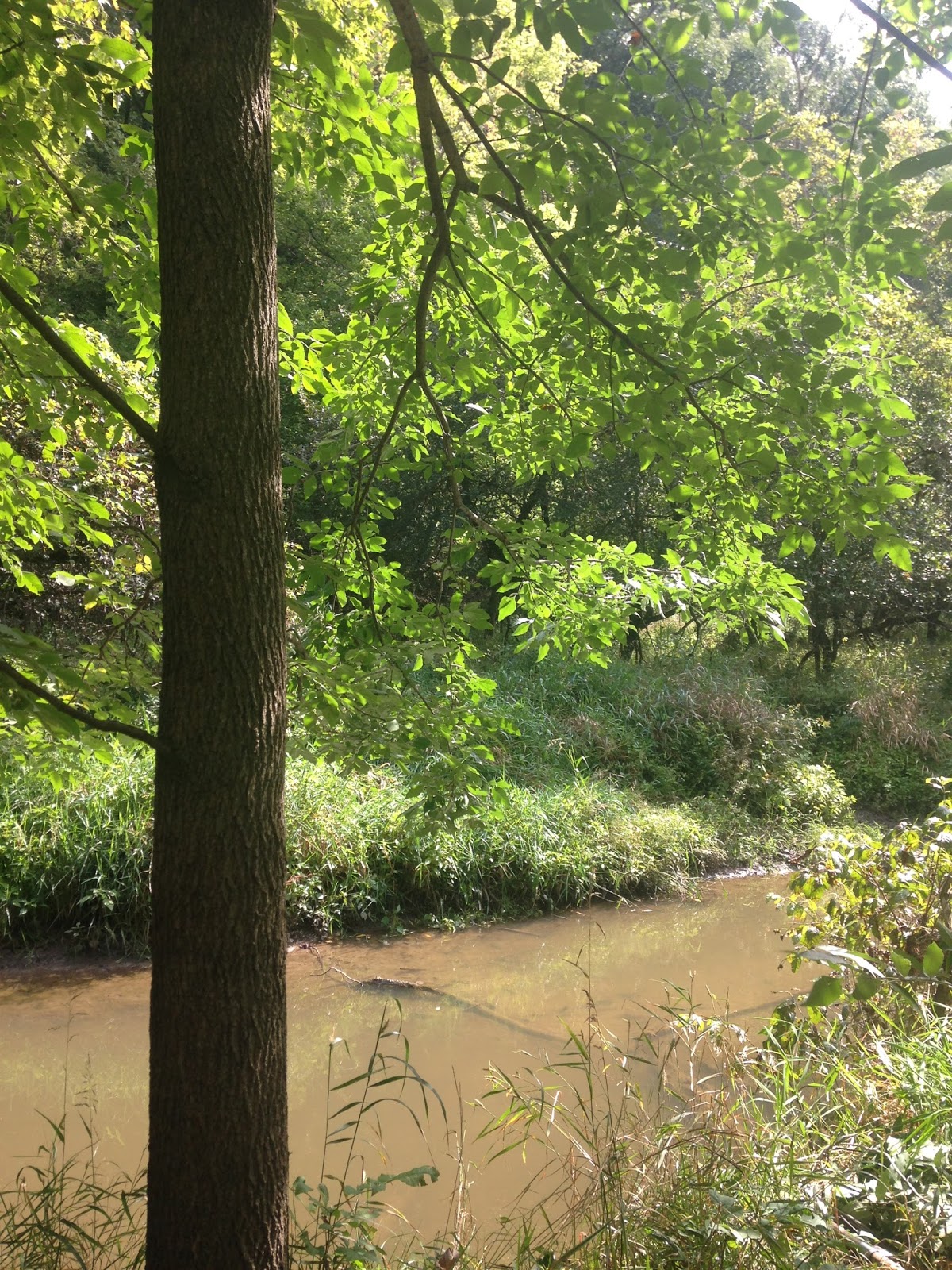
 And one of the seeding trees next to the creek

Thursday, September 22, 2016

Fall Color change in Ash tree leaves

Happy Fall Everyone! Fall reminds me of pumpkins, nice 70 degree days, and fall leaf color change.
 Recently, I got to go look for tree leaf color change in black ash trees from a helicopter. The red in the picture above is from maple trees. Ash have a light green to yellow leaf color occurring around now. Black ash are a species of ash tree that is usually found in very wet habitat, wetland for example. There are not too many around our area in NW Ohio, but there is in Michigan. The US Forest Service is interested in looking for tree still alive after the initial die-off from of EAB (Emerald Ash Borer), as they continue to try to breed EAB resistant ash trees. Black ash is the American ash species that is the most similar species to Asian ash/Manchurian Ash.

Here are a few other breath-taking pictures I took from the helicopter.